
Transform Your Smile with Custom Porcelain Veneers — Chicago’s Digital Design Difference
If you’ve been quietly holding back your smile—choosing closed lips in photos, laughing with your hand over your mouth, or avoiding mirrors—porcelain veneers could be the change you’ve been looking for. At Dr. Bianca Clark’s cosmetic dental practice in Chicago, we create custom porcelain veneers that correct chips, cracks, stains, gaps, and uneven teeth while looking so natural, only you’ll know they’re there.
What sets us apart from other cosmetic dentists near you in Chicago is our commitment to precision and transparency. Using in-house EXOCAD digital design technology, Dr. Clark builds a digital model of your new smile and lets you see and approve your results before a single tooth is touched. There’s no guesswork—just a clear, collaborative process that delivers the smile you actually want.
Ready to see what’s possible? Call us at (312) 212-3304 or keep reading to learn everything you need to know about porcelain veneers in Chicago, IL.
What Are Porcelain Veneers?
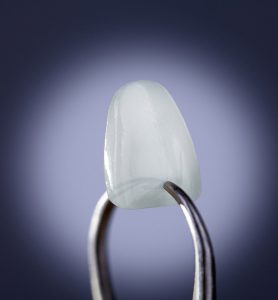
Porcelain veneers are ultra-thin, custom-crafted shells, typically between 0.3 and 0.5 millimeters thick, made from high-quality dental porcelain or ceramic. They’re bonded directly to the front surface of your teeth, instantly changing their color, shape, size, or length.
Think of a veneer as the cosmetic equivalent of a new façade: your natural tooth remains intact underneath, while the outside is completely transformed. Because dental porcelain reflects light the same way natural tooth enamel does, veneers don’t look fake or opaque. They blend seamlessly into your smile — and they resist staining from coffee, red wine, and tea far better than natural teeth.
Porcelain veneers are one of the most versatile treatments in cosmetic dentistry. A single veneer can fix a chipped tooth. A set of six to ten veneers can completely redesign your smile. The results are immediate, long-lasting, and — when done well — completely undetectable.
What Problems Do Porcelain Veneers Correct?
Patients visiting our cosmetic dental office near you in Chicago come to us with a wide range of concerns. Porcelain veneers are one of the few treatments that can address multiple issues in a single procedure:
- Severe Discoloration and Deep Staining: Veneers cover stains that professional whitening can’t touch—including tetracycline antibiotic staining, fluorosis (white spots from excess fluoride), and intrinsic discoloration that lives inside the tooth rather than on the surface.
- Chips and Cracks: A chipped front tooth is one of the most common reasons patients search for a cosmetic dentist near them. Veneers restore the shape and protect the tooth from further damage in a single appointment.
- Gaps and Spacing: Small spaces between teeth — including a diastema (gap between front teeth) — can be closed with veneers without braces or orthodontic treatment.
- Worn-Down or Short Teeth: Years of grinding, acidic foods, or simply aging can erode enamel and shorten teeth. Veneers rebuild length and restore proper proportions.
- Minor Misalignment: Slightly crooked, overlapping, or rotated teeth that don\’t require orthodontics can be visually corrected with veneers—sometimes called “instant orthodontics.”
- Irregularly Shaped Teeth: ‘Pointed canines, small “peg” lateral incisors, or naturally uneven teeth can be reshaped and resized for a balanced, proportional smile.
- Uneven Gum Lines: When combined with gum contouring, veneers can correct the appearance of a “gummy smile” or uneven gum levels.
Not sure if veneers are right for your situation? Dr. Clark offers consultations for patients throughout Chicago—including River North, Lincoln Park, West Town, Little Italy, Wicker Park, and the greater Chicagoland area. Call (312) 212-3304 to find out if you’re a candidate for porcelain veneers.
The Dr. Bianca Clark Difference: Digital Design + Biomimetic Dentistry
Not all cosmetic dentists approach veneers the same way. Dr. Clark combines two disciplines that most practices don’t offer together: digital design precision and biomimetic dentistry philosophy.
Biomimetic dentistry is a philosophy centered on preserving as much of your natural tooth structure as possible. Traditional veneer preparation can sometimes remove more enamel than necessary. Dr. Clark’s biomimetic approach means your veneers are crafted to require only the minimal enamel reduction needed—protecting your long-term dental health while still delivering dramatic aesthetic results.
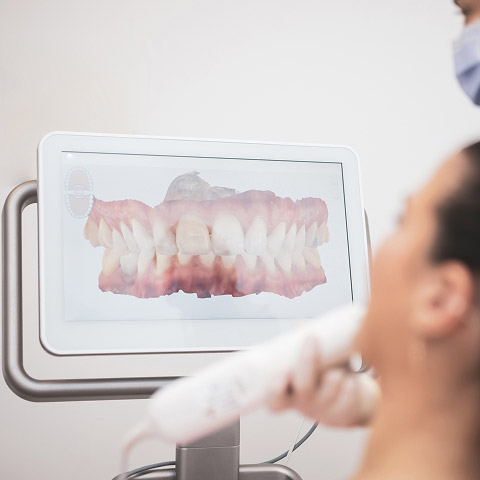
EXOCAD is professional-grade dental CAD software used by leading cosmetic practices worldwide. Dr. Clark uses it in-house to digitally design your new smile with microscopic precision. The software maps your tooth anatomy, facial proportions, lip line, and bite to create a veneer design that’s uniquely engineered for your face—not a template applied to everyone.
This matters because one of the most common complaints patients have after veneers elsewhere is that their new smile looks “done” or doesn’t suit their face. At our Chicago dental practice, the digital design process eliminates that risk.
Dr. Clark can merge your digital veneer design with actual photos of your face, so you can see — in real images, not just 3D renders — what your results will look like. You’ll review and approve the design before any preparation begins. Physical prototypes are also created so you can evaluate the feel, proportion, and look of your new smile at a 48-hour evaluation appointment.
This preview process is a genuine differentiator. Most cosmetic dentists in Chicago don’t offer a physical prototype stage before final placement.
Our Porcelain Veneer Process: What to Expect, Step by Step
One of the most common questions we hear from patients searching for porcelain veneers near them is, “What actually happens at each appointment?” Here’s the full picture of the porcelain veneer procedure, so there are no surprises.
Step 1 — Digital Smile Design Consultation
Your journey begins with a comprehensive consultation. Dr. Clark takes high-resolution photographs, conducts a digital analysis using EXOCAD, and sits down with you to understand your goals—not just for your teeth, but for how your smile fits your face, your personality, and your lifestyle. She’ll evaluate your oral health to confirm you’re a strong veneer candidate and discuss all your options honestly, including alternatives if veneers aren’t the right fit.
Step 2 — Smile Preview
Dr. Clark merges your digital veneer design with your actual smile photos. You receive detailed images to review at home and provide feedback. This isn’t a quick mockup—it’s a precise, patient-approved design that drives everything that follows. Want something slightly brighter? More natural? Adjustments happen here, not after placement.
Step 3 — Prototype Creation & Preparation
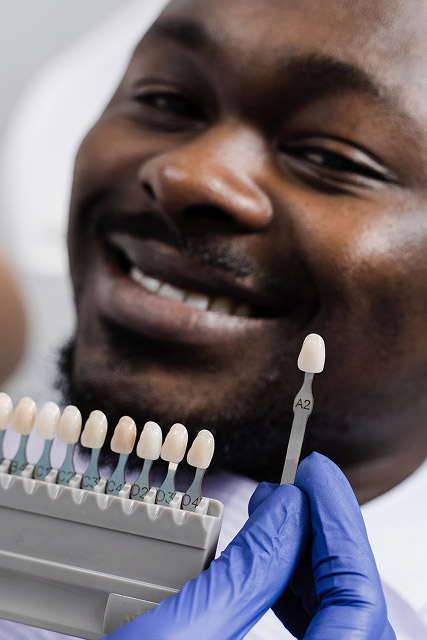
At your preparation appointment, Dr. Clark creates physical prototypes of your veneers and conducts a detailed shade evaluation. Using minimally invasive techniques, she prepares your teeth by removing only the precise amount of enamel required — guided by the biomimetic principle of preserving natural tooth structure. Temporary veneers are placed so your teeth are protected while your permanent veneers are fabricated.
Step 4 — 48-Hour Evaluation
You return within 48 hours to evaluate the prototypes in real-world conditions—after eating, speaking, and smiling in different lighting. This is your final opportunity to request any refinements before your permanent veneers are fabricated. Most patients are thrilled at this stage; the few who want adjustments get them with no added stress.
Step 5 — Custom Fabrication
Your permanent veneers are crafted using advanced 3D printing technology and premium dental-grade porcelain. Every veneer is fabricated to your approved design specs with laboratory-level precision, ensuring color, shape, and translucency all match what you previewed.
Step 6 — Final Placement & Evaluation
At your final appointment, Dr. Clark bonds your custom veneers to your teeth using high-strength dental cement. She evaluates fit, bite, aesthetics, and comfort before you leave. Photographs are taken for your records. Most patients leave this appointment genuinely emotional—the transformation is that significant.
Total treatment time from consultation to placement typically spans three to five weeks, depending on your specific case and any adjustments needed.
Types of Veneers We Offer at Our Chicago Office
Dr. Clark offers three veneer options at her West Loop practice, each selected for its ability to deliver natural, long-lasting results. During your consultation, she’ll recommend the option that best fits your anatomy, goals, and the specific concerns you want to address.
Porcelain Veneers
The gold standard in cosmetic dentistry — and Dr. Clark’s most frequently recommended option. Traditional porcelain veneers are layered by hand to replicate the subtle translucency and surface texture of natural tooth enamel. They offer superior light reflection, exceptional stain resistance, and a lifespan of 15 to 20+ years with proper care. Whether you’re correcting chips, closing gaps, masking deep stains, or redesigning your full smile, porcelain veneers deliver the most comprehensive and durable results available in cosmetic dentistry today.
Ceramic Veneers
All-ceramic veneers use a monolithic ceramic core rather than a layered porcelain structure, making them exceptionally strong without sacrificing aesthetics. They offer excellent light transmission, precise color matching, and are an outstanding choice for patients with heavier bite forces or those who want maximum durability over the long term. Ceramic veneers are milled rather than hand-layered, which gives them a consistent internal structure — and when paired with Dr. Clark’s EXOCAD digital design process, the results are just as natural and beautiful as traditional porcelain.
Digital Design Veneers
Digital Design Veneers aren’t a separate material—they’re what Dr. Clark calls the complete EXOCAD-driven treatment experience applied to your veneer case. Every veneer Dr. Clark places is digitally designed, but this designation specifically describes cases where patients engage the full preview process: digital smile modeling, photo-merged preview images, and a physical prototype evaluation period before permanent veneers are fabricated. If seeing your result before you commit is important to you — and it should be — Digital Design Veneers are the way to go. This process is available for both porcelain and ceramic veneer cases.
Other Veneer Options You May Have Heard About
If you’ve been researching veneers online, you’ve probably come across several other types—composite veneers, no-prep veneers, Lumineers, and zirconia veneers, among others. Dr. Clark’s practice currently focuses on porcelain and ceramic veneers, but we want you to walk into your consultation fully informed. Here’s a straightforward breakdown of what these other options are and how they compare:
Composite resin veneers are made from tooth-colored bonding material sculpted directly onto the tooth—often in a single appointment. They’re faster and less expensive than porcelain, and they’re reversible. The trade-offs: composite stains more readily (coffee, red wine, and tea will affect color over time); chips more frequently under normal use; and typically needs replacement within 5 to 7 years. For patients looking for a temporary fix or a budget-conscious option, composite can be a reasonable choice—but for longevity and aesthetics, porcelain is the better investment.
No-prep veneers (sometimes called prepless veneers) are ultra-thin shells that bond to the tooth with little to no enamel removal. They’re a strong option for patients whose teeth are naturally small or slightly recessed, where adding a thin layer of porcelain won’t make the tooth appear too bulky. However, they’re not appropriate for every case—if your teeth are already average or larger in size, prepless veneers may result in teeth that look thick or unnatural. Traditional porcelain veneers with minimal preparation often produce better outcomes for the majority of patients.
Lumineers are a brand name for a specific type of ultra-thin, no-prep veneer, roughly the thickness of a contact lens. Because they’re so thin, they’re marketed as a reversible veneer option. They work well for a narrow range of cases — primarily patients with very small or slightly dark teeth who want a minimal change. For patients with significant cosmetic concerns, Lumineers often don’t provide enough coverage or correction to achieve the dramatic transformation most patients are seeking. They’re also not available at every practice, and results vary significantly by provider.
Zirconia is an exceptionally strong dental material—stronger than porcelain or ceramic. Zirconia veneers are most commonly used in the posterior (back) teeth, where bite forces are highest, or for patients with severe bruxism (nighttime grinding) who need a material that can withstand significant force. Aesthetically, zirconia has improved dramatically in recent years, but it still doesn’t match the natural light translucency of hand-layered porcelain for front teeth. For most cosmetic veneer cases focused on the smile zone, porcelain or ceramic remains the better aesthetic choice.
Have questions about which veneer type is right for you? Dr. Clark’s consultation is designed to answer exactly that. Call (312) 212-3304 to schedule yours.
Benefits of Porcelain Veneers: Why Chicago Patients Choose Them
Veneers aren’t just about looking good in photos (though that’s a legitimate reason to get them). Here’s what patients at our Chicago dental office consistently report:
- Results Are Immediate: Unlike orthodontics or whitening treatments that require months of patience, veneers deliver a complete smile transformation in just a few appointments. Your before-and-after is dramatic—and it’s permanent.
- They Look Completely Natural: Modern dental porcelain mimics the light-reflecting properties of natural enamel, including subtle translucency and surface texture. Nobody’s veneers should look like a row of identical tiles—and Dr. Clark’s don’t.
- Stain Resistance: Porcelain doesn’t absorb pigment the way natural enamel does. Your veneers will hold their color through daily coffee, wine, and tea for years.
- Long Lifespan: With proper care, porcelain veneers last 15 to 20 years or more. Some patients’ veneers last 25+ years. This makes them an excellent long-term investment relative to repeated whitening treatments or bonding repairs.
- Minimal Invasiveness: Dr. Clark’s biomimetic approach means we remove only what’s necessary. You keep as much of your natural tooth structure as possible.
- Confidence That Compounds: This one is harder to quantify, but patients consistently report that their improved smile changes how they show up—in job interviews, on dates, and in social settings. A smile you’re proud of is one you use more freely.
- Customized to You: Every veneer Dr. Clark places is designed for your specific face, not copied from a template. Shade, shape, translucency, and length are all calibrated to your facial geometry and personal preferences.
How Much Do Porcelain Veneers Cost in Chicago?
Let’s be upfront about cost, because it’s the number-one question patients search for—and the number they deserve a straight answer on.
In Chicago, the cost of porcelain veneers typically ranges from $1,200 to $2,500 per tooth, depending on the complexity of your case, the number of veneers, and the technology and materials used. A full smile transformation with 8 to 10 veneers generally falls between $10,000 and $22,000 at most reputable Chicago cosmetic dental practices.
At Dr. Clark’s practice, pricing is based on your specific case. During your consultation, you’ll receive transparent, itemized pricing before committing to anything. We accept most major private dental insurance plans and offer flexible payment options through Cherry, a financing partner that allows you to split treatment costs into manageable monthly payments.
Important note: Cosmetic dental procedures like porcelain veneers are typically not covered by insurance. However, if there’s a functional component to your case (such as protecting cracked or worn teeth), a portion may be eligible for coverage. Dr. Clark’s team will help you understand your benefits before treatment begins.
Advanced Technology for Superior Veneer Results
The quality of your veneers is only as good as the modern dental technology behind them. At our Chicago dental office, Dr. Clark uses a suite of tools that most cosmetic dentists near you simply don’t have in-house:
- EXOCAD Digital Design Software: Industry-leading CAD software that creates a precise, patient-approved digital model of your new smile—mapping tooth anatomy, facial proportions, and bite mechanics before any physical work begins.
- In-House 3D Printing: Advanced 3D printing using complex dental-grade resins for prototype and temporary fabrication—giving you a physical preview that fits your actual teeth, not a generic model.
- High-Resolution Intraoral Camera: Captures detailed images of your teeth for accurate color matching, precise measurements, and comprehensive treatment documentation.
- Digital Shade Analysis: Precise color-matching technology ensures your veneers integrate naturally with your existing teeth and complement your skin tone.
- Eco-Conscious Materials: Clark selects plant-based, oral ecosystem-friendly products wherever possible—materials that are safe for your health and the environment.
Porcelain Veneer Trends: What Chicago Patients Are Asking For
Veneer aesthetics have evolved significantly. If your reference point for veneers is the ultra-white, perfectly uniform Hollywood smile from 20 years ago, that’s no longer what most patients want, and it’s not what modern cosmetic dentistry produces.
- Natural Shades Over Bleach-White: Today’s patients are choosing shades that reflect natural tooth enamel — subtle, age-appropriate whites that improve the smile without making it look artificial. The goal is looking like a better version of yourself, not like a different person.
- Personalized Shapes: Veneers are now designed to match individual facial geometry, lip line, and even personality. Someone with delicate features may choose softer, rounded edges. A stronger face may call for more defined angles. Dr. Clark’s EXOCAD process is built for this level of customization.
- Minimally Invasive Techniques: There’s a growing preference for no-prep and minimal-prep veneers that preserve enamel. Biomimetic dentistry—Dr. Clark’s core philosophy—is no longer a niche specialty; it’s becoming the standard patients expect.
- Digital-First Planning: Patients increasingly expect to preview their results before treatment. Practices that still rely on traditional impressions and guesswork are losing ground to those offering digital smile design, which is why Dr. Clark invested in EXOCAD and in-house prototyping.
- Texture and Translucency: Natural teeth have subtle surface texture and edge translucency. Premium porcelain veneers now replicate these micro-details, making them truly indistinguishable from natural teeth under normal lighting conditions.
How to Care for Porcelain Veneers
The good news: caring for veneers isn’t complicated. You’ll follow most of the same habits you already have for natural teeth—with a few important additions.
- Brush Twice Daily: Use a soft-bristled toothbrush and a non-abrasive toothpaste. Whitening toothpastes with coarse particles can scratch the porcelain surface over time, dulling its finish.
- Floss Daily: The gum line around your veneers still requires the same care as your natural teeth. Gum disease affects veneer longevity.
- Routine Dental Checkups: See Dr. Clark (or your general dentist) every six months. Regular professional cleanings remove plaque buildup that can compromise the bonding or surrounding enamel.
- Wear a Nightguard If You Grind: Bruxism (teeth grinding at night) is the leading cause of veneer damage. If Dr. Clark identifies signs of grinding, she’ll recommend a custom nightguard. This is a small investment that protects a much larger one.
- Avoid Using Teeth as Tools: Don’t open packages, bite nails, or chew on pens. These habits apply pressure outside of normal chewing mechanics and can chip veneers.
- Limit Alcohol-Based Mouthwash: Alcohol can weaken the bonding cement over time. Opt for an alcohol-free rinse.
With proper care, most patients’ porcelain veneers look excellent well past the 15-year mark.
Are You a Good Candidate for Porcelain Veneers in Chicago?
Most people with healthy teeth and gums are strong candidates for porcelain veneers. Candidacy is evaluated during your consultation—but here’s a general overview of what Dr. Clark looks for:
You’re likely a good candidate if you:
- Have cosmetic concerns that whitening, bonding, or orthodontics haven’t fully addressed
- Have healthy teeth and gums with no active decay or untreated gum disease
- Are committed to maintaining good oral hygiene after treatment
- Have sufficient enamel for the preparation process (very little is needed with no-prep options)
- Don’t have severe bruxism—or are willing to wear a nightguard to protect your investment
Veneers may not be recommended if you:
- Have severe tooth decay or active periodontal disease (these must be treated first)
- Are missing significant enamel (alternative options like dental crowns may be more appropriate)
- Have a misaligned bite causing significant functional issues (orthodontics may be the primary solution)
- Have habits like nail-biting or ice-chewing that could compromise the veneers prematurely
Not sure where you fall? The only way to know for certain is a consultation. Dr. Clark will give you an honest assessment and discuss alternatives if veneers aren’t the best fit for your situation.
Veneers vs. Other Cosmetic Treatments
Patients often come in having already googled whitening, bonding, and Invisalign. Here’s a direct comparison so you can walk in informed:
- Porcelain Veneers vs. Teeth Whitening: Whitening brightens natural tooth color — but it can’t change shape, close gaps, fix chips, or address intrinsic staining. For patients whose concerns go beyond color, veneers are the more comprehensive solution.
- Porcelain Veneers vs. Dental Bonding: Composite bonding is faster and less expensive, but it stains more easily, chips more frequently, and typically needs replacement within 5–7 years. Veneers are the longer-lasting, higher-quality option for patients who want results that hold.
- Porcelain Veneers vs. Dental Crowns: Crowns cover the entire tooth—all the way around. They’re the right solution when a tooth is structurally compromised. Veneers only cover the front surface, making them far less invasive for teeth that are cosmetically imperfect but structurally healthy.
- Porcelain Veneers vs. Invisalign/Braces: Orthodontics moves teeth over time—typically 12 to 24 months or more. Veneers can visually correct minor misalignment in weeks. For patients whose concerns are primarily aesthetic rather than functional, veneers may be the faster path. For significant bite or alignment issues, orthodontics is the appropriate choice.
For a full breakdown, visit our Porcelain Veneer Alternatives page.
Serving Patients Throughout Chicago and Surrounding Neighborhoods
Dr. Bianca Clark’s cosmetic dental practice is located at 955 West Monroe St. in Chicago’s West Loop—one of the most accessible locations in the city, with easy access from the Loop, Near West Side, and Fulton Market.
We regularly see patients from throughout the Chicago metro, including:
- West Loop & Fulton Market
- River North
- Lincoln Park
- Wicker Park & Bucktown
- West Town & Ukrainian Village
- Little Italy & University Village
- South Loop & Printer’s Row
- Gold Coast & Streeterville
- Oak Park, Elmhurst, and other western suburbs
- Evanston, Skokie, and northern suburbs
If you’ve been searching for a porcelain veneer dentist near you in Chicago or the surrounding area, we’d love to meet you. Call (312) 212-3304 or use the contact form below to schedule your consultation.